
Educativ
Automated, AI-driven publishing for an education platform — and the counter-intuitive result that almost all new reach came from outside the existing audience.
What this engagement was
A four-week automated publishing engagement on Facebook. The objective was not to increase posting volume for its own sake but to establish whether consistent automated output could expand reach beyond the existing follower base. It did — and the mechanism by which it did was more interesting than the headline growth.
- Client
- Educativ
- Sector
- Education
- Platform
- Engagement
- AI automation & content operations
- Period
- January – February 2025
- Duration
- 4 weeks
What was going wrong
The engagement treated scheduling and publishing consistency as the operational constraint. Manual publication limited cadence, so the work tested whether automating distribution could extend reach without also automating editorial judgement.
The client already had content worth distributing. The constraint was throughput and consistency, which is exactly the class of problem automation addresses well — as long as the automation is applied to the scheduling and distribution layer rather than to the substance of the content itself.
What we established
The reported symptom is frequently two layers above the cause. These are the findings that shaped the work.
Cadence, not content quality, was limiting reach
The project focused on frequency and consistency rather than replacing the client's editorial decisions. The available results show what happened after that change but do not isolate cadence as the only cause.
The existing audience was not the growth ceiling
Reaching more followers has a natural ceiling. The larger opportunity was in reaching people who were not yet followers but were interested in the subject matter — which requires the platform's distribution to do the work, not the follower list.
Manual scheduling does not scale with ambition
Every additional post carries a fixed human cost in scheduling, formatting and follow-up. That cost is what sets the practical ceiling on cadence.
How we worked
Including the sequencing decisions, which are usually where the work succeeds or has to be repeated.
Automate the distribution layer, not the editorial layer
Automation handled scheduling and publication across channels, keeping the cadence consistent without adding manual work. Editorial judgement about what to publish stayed with the client.
Optimise for reach beyond the follower base
The objective was to publish consistently and measure how much resulting reach came from outside the existing follower base. The audience split is reported below without claiming that cadence alone caused it.
Measure the right thing
Follower growth is a lagging and partly vanity indicator. The metrics that matter for reach are views, reach and interaction — and specifically the proportion of those coming from outside the follower base.
What was built or changed
Scope of work, grouped by area.
Automation
- Automated multi-channel scheduling
- Consistent publishing cadence without manual intervention
- Brand voice consistency across scheduled output
Measurement
- Reach and interaction tracking
- Follower versus non-follower attribution
- Engagement-quality analysis by audience segment
What made it difficult
The technical and operational constraints that shaped the work.
Automation without editorial judgement degrades a channel
Automated publishing that removes human judgement about what to publish tends to reduce quality over time. The design here deliberately kept editorial control with the client and automated only the scheduling and distribution — the part where consistency matters more than judgement.
Small absolute numbers carry large percentages
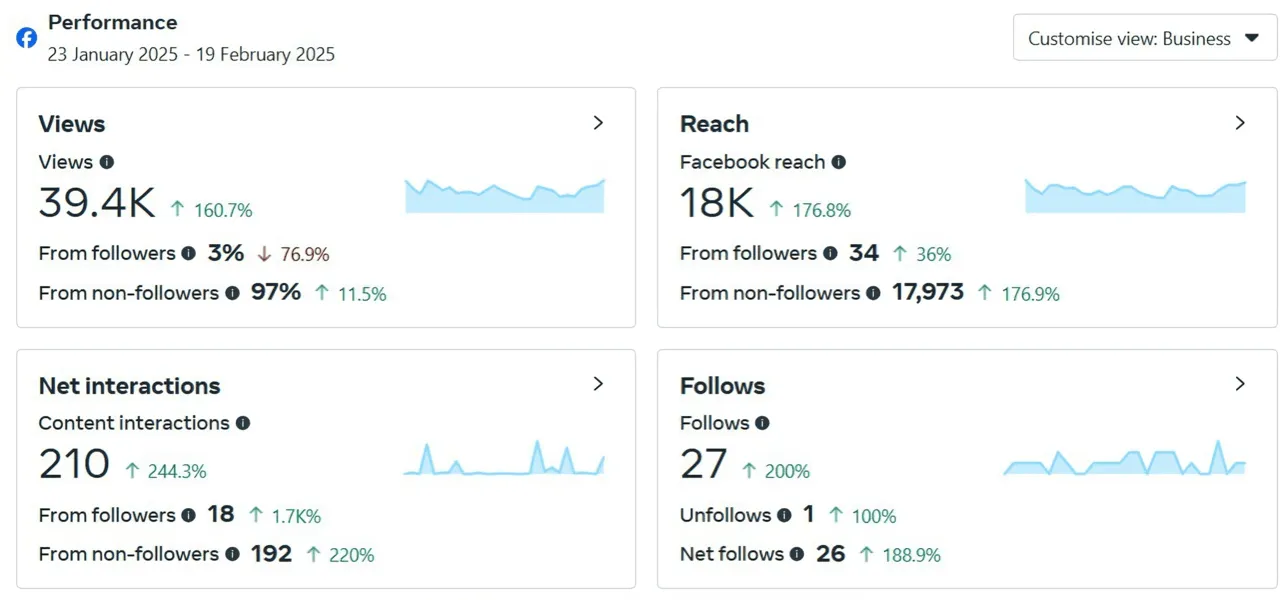
A two hundred percent increase in new follows sounds substantial and represents twenty-seven additional followers. Publishing the absolute alongside the percentage is the only honest way to present it.
What the work produced
Views rose to 39.4 thousand, up 160.7 percent. Facebook reach reached eighteen thousand, up 176.8 percent. Net interactions reached 210, up 244.3 percent, and new follows reached twenty-seven, a two hundred percent increase. Ninety-seven percent of views and 192 interactions came from non-followers, showing that most measured exposure reached beyond the existing audience. The result reflects the combined publishing cadence, creative choices and platform distribution during the engagement.
Measured outcomes
Measured outcomes from the engagement.
The lasting difference
Durable structural change rather than a one-off improvement — which is what a client is actually buying.
- Scheduling and distribution were automated while editorial selection remained with the client.
- Reach now extends beyond the existing follower base, evidenced by the proportion of views and interactions from non-followers.
- The client has a clearer model of where growth is actually coming from, which changes what subsequent content decisions should prioritise.
Capabilities used and related work
Have a system with a similar problem?
Tell us what it is doing. The diagnosis is usually the part that has been missing.