
AI search visibility, without the false promises
AI answers are becoming a distinct layer of discovery. We can improve the conditions that make a page citable and measure whether citing happens. We cannot make an AI system cite you, and any agency claiming otherwise is selling something it does not control.
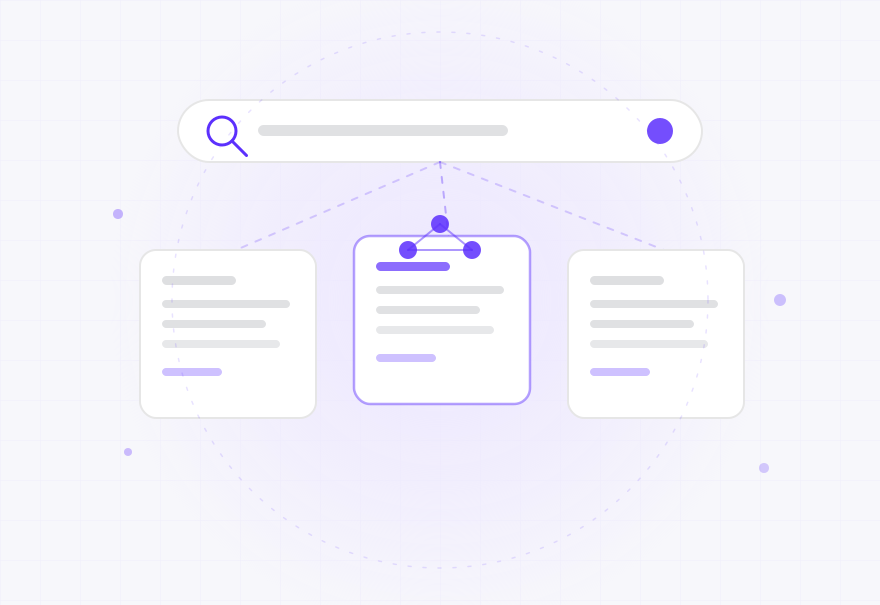
A new discovery layer with a lot of confident advice and little evidence
AI answer engines choose their own sources. That makes citation influenceable but not controllable, and the current market is full of claims about a mechanism nobody outside those systems fully understands. The practical question is narrower and answerable: is your site in a position to be cited at all?
- Competitors appear in AI answers for queries where you are absent
- You cannot tell whether AI-sourced traffic exists for your category, or how much
- Existing SEO reporting stops before the point where citations happen
- Structured information about your organisation is inconsistent across the web
- Your most authoritative content is not the content the machines can read most easily
The people who usually bring us this problem
Head of SEO / SEO Director
You have been asked for an AI visibility plan and want it grounded in what can be measured rather than what can be asserted.
CMO
You need to know whether AI search is materially affecting your category yet, and what to do that will still be correct regardless of how the answer engines evolve.
Founder
You have been pitched AI search optimisation and want a straight answer about what is real.
What this costs while it goes unfixed
Engineering faults are rarely confined to the engineering layer. These are the commercial consequences we see most often.
Being absent from answers is invisible in current reporting
Standard analytics shows you the traffic you received. It does not show you the answers you were excluded from, which is the larger and growing number.
Acting on speculation is expensive
Work undertaken for an unproven mechanism consumes the budget that would have fixed the crawl, performance and content problems that matter under both old and new discovery models.
The prerequisites are the same ones you already need
Crawlability, clean structure, accurate entities and machine-readable facts are required for AI citation and are also required for conventional search. That is the reassuring part.
Capabilities
Each of these is work we carry out, not an area we advise on.
Entity and identity consistency
AI systems resolve organisations as entities. Inconsistent naming, conflicting descriptions and unlinked profiles make that resolution harder and weaken everything downstream. This is foundational and largely determinate.
Machine-readable factual structure
Clear, structured, unambiguous statements of fact — supported by visible page content, not invented in schema. This is one of the few areas where the mechanism is legible and the benefit is defensible.
Content legibility for extraction
Answers are assembled from passages that can be lifted and quoted. Content structured so its key claims are self-contained and extractable is easier to use as a source than content that buries them.
Citation measurement
Track which queries return answers that cite you, which pages are cited, and how your citation share compares with competitors' — using third-party tooling, reported as external evidence rather than as a product result.
Topic and entity gap analysis
Establish which topics in your domain produce answers you are absent from, and whether the absence is a content gap or a legibility gap. Those have different remedies.
Discovery prerequisite enforcement
The unglamorous part that actually determines outcomes: crawlable, fast, well-structured pages with accurate metadata. Without this, nothing else in this field works.
Engineering methodology
The sequence is deliberate. The order is usually what determines whether the work holds or has to be repeated.
Separate established practice from experiment
We are explicit about which part of the work is well-founded and which is a reasonable bet. Claiming certainty about how AI systems select sources would be dishonest, and it would also make the work unfalsifiable and therefore useless.
Do the determinate work first
Crawlability, structure, entity consistency and factual clarity. These are beneficial under every plausible future, so they are never a wasted investment even if the specifics of AI search change.
Measure with third-party evidence
Citation data comes from external tooling and is presented as such. We distinguish platform actions, conventional search outcomes and AI citation outcomes as three separate things, because conflating them is how the field ends up over-claiming.
Run it as a pilot on content that deserves to be cited
The productive approach is not to submit an entire site. It is to select the URLs whose content is genuinely authoritative, remove whatever is blocking discovery, and then measure whether citations follow.
What an engagement produces
Documentation is a deliverable, not an afterthought. On most of these engagements a large part of the value is a defect report precise enough for another team to act on.
Assessment
- Entity and identity consistency audit
- Machine-readability assessment of priority content
- Citation baseline across a defined query set
- Competitor citation-share comparison
Implementation
- Structured data and factual markup for priority content
- Content restructuring for passage extraction
- Discovery prerequisite remediation
- Topic and entity gap closure
Measurement
- Citation and cited-page tracking
- Query-set monitoring over time
- Separated reporting of platform actions, search outcomes and AI outcomes
Architecture and technology
What we measure
- Queries returning answers that cite the site
- Cited pages and their topic distribution
- Citation share against a defined competitor set
- Grounding queries and the topics third-party tools associate with them
What we change
- Organisation and content entity signals
- Structured, machine-readable factual markup
- Passage-level content structure
- Crawl and indexation prerequisites
If this is not quite your problem
These overlap at the edges. Sending you to the right page is more useful than having you work it out.
AI systems are not discovering the pages at all
That is a crawl and indexation problem before it is a citation problem. See Technical SEO.
You want the measurement and the acceleration run as a programme
See the AI Crawl & Citation Acceleration solution.
Frequently asked
Can you guarantee we get cited by AI systems?
No, and nobody can. The answer engines choose their own sources and do not publish their selection criteria. What we can do is improve the conditions that make citation possible, and measure whether citing happens. Any provider guaranteeing citations is either describing something they do not control or measuring something that is not what you think it is.
Is this worth doing now, or should we wait?
The foundational work — crawlability, clean structure, consistent entities, machine-readable facts — is worth doing regardless of how AI search develops, because conventional search needs exactly the same things. The experimental work is worth doing as a bounded pilot rather than a programme. Waiting costs you the foundation; over-investing costs you the budget you need for it.
How do you measure something that is still changing?
Imperfectly, and we say so in the reporting. Citation data today comes from third-party tools with real limitations, including coverage gaps and volatility. We track direction and share rather than treating any single reading as precise, and we distinguish what we did from what changed as a result.
Does this overlap with your technical SEO work?
It shares a foundation. If the site is not crawlable and well-structured, AI search optimisation has nothing to work with. In practice most engagements start with the technical prerequisites and add the citation-specific work once the foundation is sound.
Related capabilities and work
Bring us the problem you have not been able to fix
Describe what is happening rather than what you think the cause is. If we are not the right people for it, we will say so.