
Establishing why organic traffic declined
A decline has a cause and the cause is not always available to you. This work establishes which one it is, fixes the part that is yours, and says plainly when the rest is not something anybody can recover.
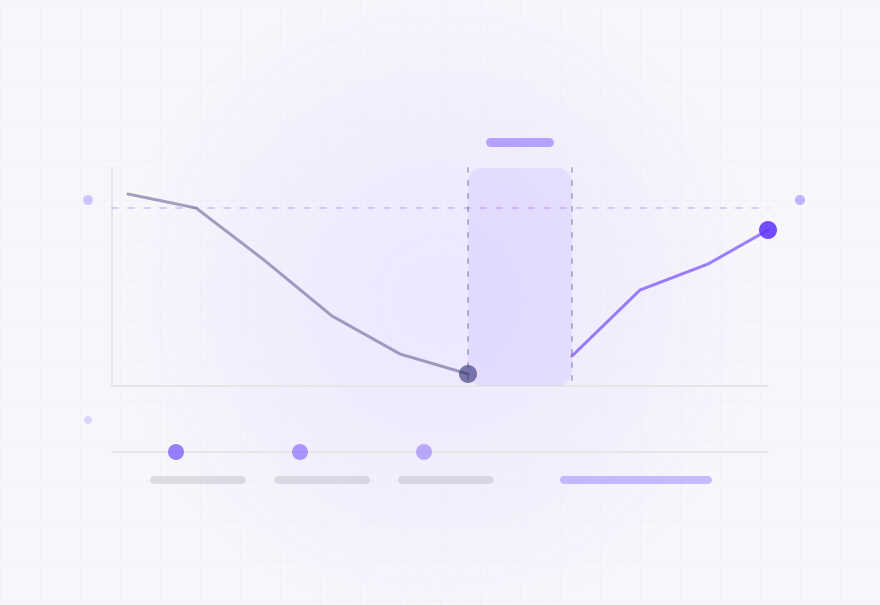
The decline is visible long before the cause is
Traffic reporting shows the shape of a decline — a step, a slope, a cliff — and the shape is the most useful evidence available, because different causes produce different shapes. Most attempts at recovery begin by changing things rather than by establishing which shape this is, which is why a site can be substantially rebuilt without the decline ever being explained.
- Impressions and clicks fell and the cause is not established
- A platform, CMS or hosting migration happened at around the same time
- The decline is a step rather than a slope, or the reverse
- It affects some page types or sections and not others
- Rankings for a set of terms disappeared entirely rather than degrading
- Crawl activity or indexation coverage changed
- Search results show a different page than the one intended for a query
- Somebody has proposed a fix and nothing has been measured since
The people who usually bring us this problem
Someone whose traffic dropped and wants the cause
You need to know what happened rather than to begin changing things and hope the number returns.
Someone who migrated and lost visibility
A move happened and the decline began near it, and you need to establish what the migration missed.
Someone whose decline has no obvious external cause
Nothing changed deliberately, which is when a slow technical degradation is the likely explanation.
What this costs while it goes unfixed
Engineering faults are rarely confined to the engineering layer. These are the commercial consequences we see most often.
Not every decline is recoverable, and saying so is the service
A decline caused by a technical fault on your site is diagnosable and usually fixable. A decline caused by a change in how a competitor or a search engine treats the subject matter is not something a provider can reverse. Establishing which one this is before proposing work is what stops a recovery engagement from becoming an expensive activity with no defined end.
We do not offer algorithm-update recovery, and the reason matters
When a search engine changes how it evaluates sites, the mechanism is external and there is no lever that reverses it. What can be established is whether the site has a technical property — thin content at scale, an indexation problem, a rendering dependency, a page-experience defect — that has become more consequential. If it has, that is a real finding and fixing it is real work. It is not the same as restoring the previous position, and no provider can promise that.
The shape of the decline narrows the cause faster than anything else
A step change points at a single event: a migration, a redirect error, a robots change, a canonical mistake. A slope points at something degrading, or at a competitive shift. A cliff affecting one section points at a template or a page type. Reading the shape first is cheaper than any amount of inspection.
A fix applied without a baseline cannot be evaluated
Recovery work begins by recording the current state precisely, because otherwise a later improvement cannot be attributed and a later further decline cannot be explained. Sites that have been through several rounds of unfocused changes are much harder to diagnose than ones that were left alone.
Capabilities
Each of these is work we carry out, not an area we advise on.
Decline characterisation
The shape, the timing, the segments affected and the metrics involved — impressions against clicks, coverage against rankings, one section against the site. Establishing this first is what makes the diagnosis directed rather than a survey.
Migration gap analysis
Where a move happened near the decline: whether the redirect map was complete, whether status codes and canonicals agree, whether whole URL classes were left unmapped, and whether internal links still route through redirects. This is the most common single cause, and it is checkable.
Indexation and coverage diagnosis
What is indexed, what has been dropped, and why — including pages excluded by a rule nobody intended, canonical conflicts, and content that is reachable only through a path a crawler will not take.
Crawl and rendering analysis
What a crawler receives, whether it is crawling at the rate it used to, what is blocking it, and whether anything depends on client-side execution. Rendering problems frequently present as a content or ranking problem and are not one.
Server and reliability correlation
Whether the decline follows a period of error responses, outages or wasted crawl — which reduces crawl rate and delays discovery, and which is invisible in a reporting dashboard that only counts sessions.
Content and structure change review
What changed on the site: templates, URL patterns, internal linking, pagination, structured data, content removed or consolidated. Deliberate changes that were not evaluated for their search consequence account for a significant share of declines.
Recovery plan, ordered and measurable
The fixes in the order they matter, each with the measurement that will show whether it worked. Ordered by evidence rather than by effort, so a large change is not made before a small one that would have answered the question.
Honest reporting on what did and did not recover
Measurement against the recorded baseline, for as long as it takes for the trajectory to be legible, with the parts that did not recover stated as such. A recovery report that only lists the improvements is not a report.
Engineering methodology
The sequence is deliberate. The order is usually what determines whether the work holds or has to be repeated.
Characterise before investigating
Shape, timing, segmentation. It costs little and it usually names the likely cause before any inspection begins, which is what keeps the work proportionate to the problem.
Record a precise baseline immediately
Before changing anything. Current coverage, current impressions and clicks by page type, current crawl behaviour. Everything afterwards is judged against this, and without it the engagement has no way to conclude.
Check the correlate before the theory
If something changed on the site near the decline, that is where to look first — not because correlation is causation, but because a deliberate change is the one cause that is both common and checkable. Migrations, template releases, URL changes and hosting moves are all in this category.
Distinguish what is yours from what is not
A technical fault is fixable, an evaluation change is not. Establishing which one this is happens early and is stated plainly, because a client who believes they are buying a reversal and is receiving a diagnosis will judge the work as a failure regardless of its quality.
Fix in evidence order, one at a time
Highest-confidence cause first, measured before the next. Recovery is not a bundle, and a set of simultaneous changes that coincides with an improvement leaves nobody knowing what worked — which matters if it declines again.
Wait long enough to conclude
Crawl responses appear in days, indexation in weeks, impressions and clicks after that. Reporting before the trajectory is legible produces a conclusion that the next month contradicts, so the measurement window is part of the plan.
Report what did not recover
Including the parts that were fixed and did not help, and the parts that were never addressable. That is what makes the report usable for the next decision rather than only for reassurance.
What an engagement produces
Documentation is a deliverable, not an afterthought. On most of these engagements a large part of the value is a defect report precise enough for another team to act on.
Diagnosis
- Characterisation of the decline: shape, timing, segments, metrics
- Baseline recorded before any change
- Every correlate on the site near the decline, checked
- The causes found, ranked by confidence and by evidence
- The causes that cannot be established, stated as such
- Which parts are technically fixable and which are not yours to fix
Recovery
- Fixes in evidence order, each with its own measurement
- Redirect, canonical and status-code corrections where a migration caused it
- Indexation blocks removed and rules that excluded pages corrected
- Crawl and rendering constraints addressed
- Server reliability correlation handled where it contributed
Reporting
- Measurement against the recorded baseline, over a legible window
- What recovered, what did not, and what changed as a result
- Where the trajectory is still settling
- What to watch so a recurrence is noticed early
- An honest account of what was never addressable
Architecture and technology
Shapes of decline and what they suggest
- A step on a specific date — a single event: a migration, a rules change, a release
- A slope over months — something degrading, or a competitive shift
- A cliff in one section or page type — a template, a pagination or a canonical defect
- Rankings lost but impressions maintained — a title, intent or result-presentation change
- Coverage falling while rankings hold — an indexation constraint
- Clicks falling while impressions hold — result presentation or click-through
- Everything falling at once — usually an availability, robots or rendering failure
What is diagnosable from here, and what is not
- Diagnosable: migration gaps, redirect and canonical errors, indexation rules, rendering dependencies, crawl constraints, reliability correlation, template defects
- Diagnosable but not yours: deliberate content decisions with search consequences
- Not addressable: a change in how a search engine evaluates a subject
- Not addressable: a competitor earning a position you held
- Not addressable: demand for the subject falling
If this is not quite your problem
These overlap at the edges. Sending you to the right page is more useful than having you work it out.
A migration happened and the decline followed
The general migration discipline, including what a complete redirect map requires.
Website migrationsCoverage or crawl behaviour changed
The discipline below the symptom: what is crawlable, indexable and reachable.
Crawl and indexationThe cause may be server reliability
Error responses reducing crawl rate, and what to do about it.
SEO server error remediationYou want the whole position established
A technical audit delivered as a prioritised engineering backlog.
Technical SEO auditFrequently asked
Can you recover traffic lost after a Google update?
Not in the sense that question usually means, and no provider can. When a search engine changes how it evaluates sites the mechanism is outside your control and there is no lever that reverses it. What we can establish is whether the decline has a technical explanation — an indexation constraint, a rendering dependency, thin content at scale, a page-experience defect that has become more consequential — because those are real findings and fixing them is real work. If the cause is the evaluation change itself, we will say so, and we will not sell a recovery engagement against it.
How quickly will we know what happened?
The diagnosis is usually the fast part — days rather than months, because the evidence is available and the causes are finite. Recovery is the slow part: crawl behaviour responds within days, indexation over weeks, and impressions and clicks after that. We will not conclude before the trajectory is legible, because a conclusion drawn too early tends to be contradicted by the following month, and a reporting cycle that flip-flops is worse than no reporting.
We already made changes and nothing improved. Does that make it harder?
It does, and it is worth saying before work begins. Changes made without a recorded baseline remove the comparison, so establishing what the decline was caused by becomes harder — and if several changes were made at once, it is not always possible to attribute the current state to any of them. In those cases the diagnosis starts by establishing the present state precisely and treating it as the new baseline, which is usually still tractable, but it takes longer than it would have from an untouched site.
What if you find nothing wrong?
Then that is the finding, and it is a useful one — a site with no technical fault has a decline that is not technical, which points at the content, the competitive position or the subject's demand. We will say that plainly rather than proposing a programme of changes to have something to do. The deliverable in that case is the evidence: what was checked, what it showed, and the explanation that best fits, along with the things worth watching so a technical cause is noticed if one develops.
Do you need access to Search Console and analytics?
They materially improve the diagnosis and are close to essential for it. Search Console carries coverage and indexation data, query-level impressions and clicks, and crawl statistics that cannot be inferred from outside — plus the manual action and security sections, which occasionally explain an otherwise inexplicable step change in a single answer. Analytics carries the segmentation that distinguishes a real decline from a tracking change, which is not a rare false alarm.
Related capabilities and work
Bring us the problem you have not been able to fix
Describe what is happening rather than what you think the cause is. If we are not the right people for it, we will say so.