

Platform Engineering

Managed infrastructure for a production XenForo community

A forum's load is set by its members' habits, not by a marketing calendar. Capacity is decided by the peak hour of a community's day, and the peaks are predictable right up until they are not. We operate the layer that has to hold under both.

The problem

Forum infrastructure is provisioned for the average and fails at the peak

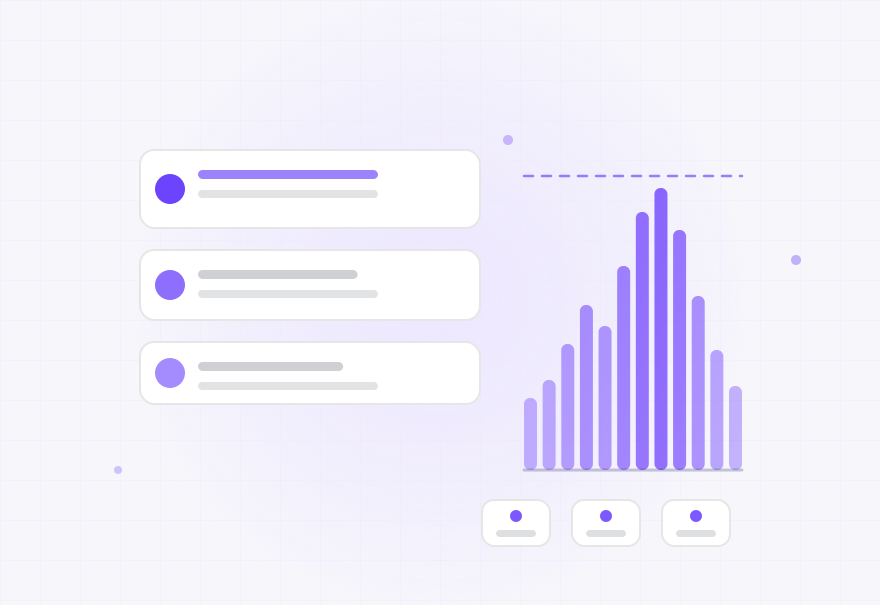
A community's traffic concentrates. Evenings, a breaking news event, a thread that catches fire, a migration that brings a spike of returning members — the busiest hour of a forum's week can be several times its average, and the timing is not chosen by anyone running the site. Sizing for the average produces a platform that is comfortable most of the time and unavailable exactly when its audience is present, which is the failure it will be judged on.

  • The forum slows or fails during its busiest hours and recovers afterwards
  • Performance degrades as discussion history and attachments accumulate
  • Search across the community has become noticeably slow
  • Page generation time has crept up without any single change explaining it
  • Backups run during peak hours and affect responsiveness
  • Nobody can say whether the current specification is still adequate
  • A previous traffic spike caused an outage that was resolved reactively
  • The server has no monitoring beyond whether a page responds
Who this is for

The people who usually bring us this problem

A community owner whose forum has outgrown its hosting

The site works but not reliably, and you need infrastructure sized for how the community actually behaves rather than for a specification someone guessed at.

An operator with several communities

You want consistent infrastructure and a consistent operating standard across installations rather than a different arrangement on each.

Someone who has been managing the server personally

You have been doing this yourself and you need it to be somebody's actual responsibility, with documentation, before something fails while you are away.

What it costs

What this costs while it goes unfixed

Engineering faults are rarely confined to the engineering layer. These are the commercial consequences we see most often.

Unavailability at peak is the failure the community remembers

A forum that is slow at six in the evening is unavailable to most of its audience most days. The judgement members and advertisers make is formed in those hours, not across the monthly average.

Community platforms do not degrade gracefully

Query cost and storage grow with history, and attachment sets only ever grow. Capacity that was comfortable at one size becomes abruptly inadequate at another rather than declining gradually, which removes the warning a gradual decline would have given.

Member trust is the asset, and it is the one thing an outage spends

Posts lost, sessions dropped and periods of unavailability cost participation. That is not recoverable by restoring a backup, because it is a behavioural cost rather than a data one.

Unmeasured infrastructure cannot be planned for

Without baseline instrumentation, whether the forum feels slow is the only available signal, and it arrives after the problem is established rather than before.

What we do about it

Capabilities

Each of these is work we carry out, not an area we advise on.

Onboarding inventory

What is running, at which versions, on what specification, with which extensions and what the current load profile looks like. Established from the environment rather than from its documentation, because on community platforms those frequently disagree.

Capacity review against real peaks

Sizing derived from observed peak behaviour rather than from average traffic, with headroom estimated for the events a community actually produces — a viral thread, a migration bringing members back, a news event in the forum's subject.

Application and database tuning

Web server, application runtime and database configuration tuned to the platform's actual query patterns. Community platforms have characteristic hot paths and tuning them generically leaves most of the available improvement unclaimed.

Caching and content delivery

Caching strategy and edge delivery configured with awareness of what a forum can and cannot cache. Logged-in community traffic is largely uncacheable, and a configuration that assumes otherwise produces a cache with almost no hit rate.

Backup and restore verification

Backups sized and scheduled around a community's load, with restore actually tested. On a forum the attachment store usually dominates backup size, which is why its retention is a decision rather than a default.

Monitoring against the right signals

Availability, response time, resource use and database health, instrumented so a developing capacity problem is visible before it becomes an outage rather than after.

Search infrastructure

Forum search behaves differently from site search, particularly over long histories. Where the platform delegates search, that layer is part of the platform and is operated as such.

Ongoing operational ownership

Patching, upgrades, capacity management, incident response and reporting, with an agreed shared-responsibility boundary and a written escalation path.

How we work

Engineering methodology

The sequence is deliberate. The order is usually what determines whether the work holds or has to be repeated.

  1. Measure the community's actual behaviour first

    Peak-to-average ratio, when peaks occur, how long they last and what drives them. A forum's load shape is its own and it determines every sizing decision — so it is established from observation rather than from a hosting tier.

  2. Separate the tiers that should be separate

    Application, database and static assets are separated where the load shape justifies it and left together where it does not. On a community platform, the database is usually the tier that decides the ceiling.

  3. Tune the platform's own hot paths

    Community software has characteristic expensive queries — unread state, search, thread rendering at depth. Tuning those is worth more than generic server optimisation, and profiling is what identifies them.

  4. Size for the peak and verify under it

    The configuration is validated against load representative of the busiest period, not against a normal afternoon. Testing at average load confirms that nothing is obviously broken, which is a much weaker statement.

  5. Schedule the work that can affect members outside their hours

    Backups, reindexing and heavy maintenance run when the community is quiet, defined by observed behaviour rather than by a default window.

  6. Own it continuously, and report it

    An environment that is watched occasionally is not managed. The commitment is a cadence of work, a named escalation path and a recurring report, so the community's infrastructure is somebody's actual responsibility.

Deliverables

What an engagement produces

Documentation is a deliverable, not an afterthought. On most of these engagements a large part of the value is a defect report precise enough for another team to act on.

Onboarding

  • Environment and version inventory
  • Observed load profile including peaks
  • Capacity assessment with headroom analysis
  • Backup review and a tested restore
  • Monitoring baseline and alert routing
  • Agreed shared-responsibility boundary

Operating

  • Platform and dependency patching on a schedule
  • Capacity management against observed peaks
  • Availability, performance and database monitoring
  • Backup monitoring and periodic restore testing
  • Maintenance windows scheduled around community behaviour
  • Incident response within an agreed escalation path

Reporting

  • Recurring report of availability, performance and capacity
  • Change log attributed and dated
  • Capacity forecast with the assumptions stated
  • Documentation kept current as the environment changes
Under the hood

Architecture and technology

What a community platform demands

  • Sizing against peak rather than average load
  • A database tier sized for history, not for current content volume
  • Attachment storage that grows monotonically and is retained deliberately
  • Caching configured for what a forum can actually cache
  • Maintenance work scheduled outside observed busy periods
  • Monitoring that shows developing pressure before it becomes an outage

What we are not

  • We are not a hosting reseller — you keep the commercial relationship and the ability to move
  • We do not operate datacentres or claim to
  • We do not publish a supported operating system, runtime or database range we have not verified for your installation
  • We do not provide round-the-clock cover unless separately contracted
Related work

Where we have done this

Engagements where this capability was the substance of the work rather than a line item.

Online communities

Spain's largest forum

Since 2019, Soludome has managed infrastructure and platform operations for one of Spain's largest online communities. The work covers server and performance optimisation, CDN architecture, load balancing and site security under sustained traffic.

Since 2019continuous engagement
Online communities & specialist publishing

GuzziTech & RideMalibu

Since 2021, Soludome has managed infrastructure, site performance and technical SEO across GuzziTech and RideMalibu as a connected web estate. The engagement includes dedicated infrastructure and continuing operational ownership.

Since 2021managed infrastructure, performance and SEO
Adjacent problems

If this is not quite your problem

These overlap at the edges. Sending you to the right page is more useful than having you work it out.

You need the platform developed rather than operated

Extensions, templates and upgrade work differ from running the environment.

XenForo development

You are moving the community to a new server

The cutover itself is a project rather than a transfer.

Server migration

The bottleneck is the application rather than the machine

Query plans and template cost are development concerns rather than hosting ones.

Custom XenForo add-on development

The community is failing under hostile traffic

Attack traffic is a security problem before it is a capacity one.

Website security
Questions

Frequently asked

Are you a hosting company?

No. We operate environments on infrastructure you own or rent directly from a provider, and we do not resell hosting or mark it up. That keeps the commercial relationship and the ability to leave with you, which is the arrangement we would want if we were the buyer. If your requirement is a host rather than an operator, we are not the right answer and we will say so.

Our forum is slow at peak. Will more memory fix it?

Sometimes, and it is worth establishing which problem you have before buying anything. A community platform can be slow at peak because the machine is genuinely undersized, because a handful of queries are expensive at scale, because caching is configured for traffic that cannot be cached, or because maintenance is running during busy hours. Those have four different fixes and only one of them is hardware. Profiling comes first.

Which operating systems and software versions do you support?

We will confirm that for your specific installation rather than publishing a matrix. Support windows for the operating system, runtime and database move independently, and a published range ages into being misleading. What we will tell you is what your installation is running, whether it is still receiving security updates, and what the upgrade path looks like.

Can you reduce our hosting costs?

Sometimes, and we have done it — one long-running engagement began with a move to more cost-effective infrastructure without a performance loss. It is not the usual outcome of a capacity review, though, and we will not present it as the goal. The honest position is that a forum's costs are driven by its peak load and its attachment storage, and both are consequences of its success.

What happens during a traffic spike?

By the time a spike arrives, the only thing that can help is having sized for it beforehand. We watch for developing pressure, keep headroom against observed peaks, and will tell you what the platform can absorb and what it cannot. What we cannot do is create capacity instantly, and a page that implies otherwise is describing an autoscaling story that community software rarely supports well.

Do you take over an existing server we already have?

Yes, and that is the usual starting point rather than a fresh build. The work begins with an inventory and a measured load profile, then a tested restore. Most inherited forum environments are broadly sound and undocumented; the valuable part of the first month is usually the document nobody had rather than the changes nobody had made.

Bring us the problem you have not been able to fix

Describe what is happening rather than what you think the cause is. If we are not the right people for it, we will say so.